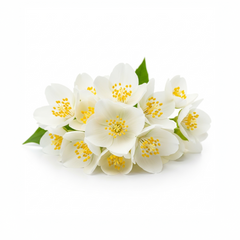
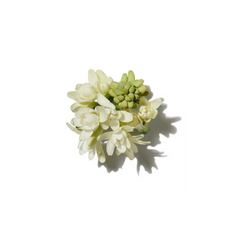
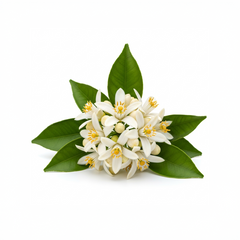
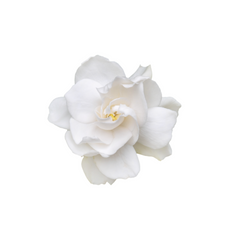
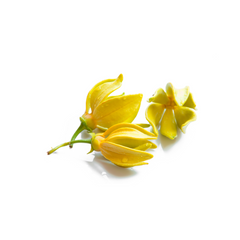
White flowers in perfumery refer to a group of blossoms—most notably jasmine (Jasminum grandiflorum and Jasminum sambac), tuberose (Polianthes tuberosa), gardenia (Gardenia jasminoides), orange blossom (Citrus aurantium), and lily of the valley (Convallaria majalis)—that share a creamy, narcotic, and sometimes animalic scent profile. The defining molecular signature is indole (C8H7N, CAS 120-72-9), present at trace levels in natural extracts, which imparts a heady, almost fleshy quality. Other key molecules include benzyl acetate (fruity, sweet), methyl anthranilate (grape-like, floral), and cis-jasmone (green, jasmine facet). These compounds, especially indole, are responsible for the duality of white flowers: radiant and pure at low concentrations, but carnal and even slightly dirty when concentrated or overdosed.
In perfumery, white flowers are almost always used as heart notes, providing the central theme or bouquet in a composition. They are typically dosed at 1–5% of the formula, though in soliflore or “big white floral” fragrances, this can rise to 10% or more. Their interaction with skin chemistry is notable: indole and related molecules can be amplified by body heat and skin pH, sometimes producing a more animalic or musky effect on warmer or more acidic skin. This variability is part of what makes white floral fragrances so personal and polarizing.
White flowers in perfumery are exemplified by iconic fragrances such as Fracas by Robert Piguet (1948, Germaine Cellier), which showcases tuberose’s creamy, green, and camphoraceous facets, and Dior J’adore (1999, Calice Becker), which blends jasmine, ylang-ylang, and magnolia for a luminous, modern white floral accord. More recently, Mugler Alien (2005, Dominique Ropion and Laurent Bruyère) uses jasmine sambac absolute for a solar, indolic heart, while Chanel Gabrielle (2017, Olivier Polge) combines jasmine, ylang-ylang, orange blossom, and tuberose in a radiant bouquet.