Where Myrrh Comes From — Origin & Extraction
Myrrh is the aromatic oleoresin exuded by Commiphora myrrha, a small, thorny tree native to the arid regions of the Horn of Africa and the Arabian Peninsula. The primary producing countries are Somalia (accounting for over 60% of global supply), Ethiopia, Eritrea, and Yemen. Annual world production is estimated at 2,000–2,500 metric tons, with Somalia’s Bari and Sanaag regions being the most significant exporters.
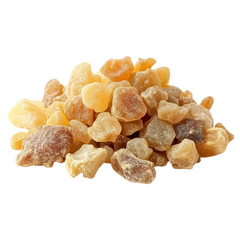
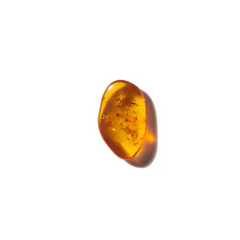
Harvesting involves making deliberate incisions in the tree’s bark, causing it to secrete a pale, sticky latex. This resin hardens into reddish-brown “tears” within hours, which are collected after two to three weeks. The raw gum consists of 30–60% water-soluble gum, 25–40% alcohol-soluble resin (rich in terpenoids and steroids), and 2–10% volatile essential oil. Extraction for perfumery is performed via steam distillation (yielding a lighter, more aromatic oil dominated by sesquiterpenes), CO2 extraction (capturing heavier, more complete fractions), or solvent extraction for absolute (preserving the full aromatic spectrum, including bitter and medicinal notes). Typical yields for essential oil are 3–8% by weight of raw resin.
Natural myrrh absolute commands prices of $800–1,200/kg, while synthetic substitutes (e.g., synthetic curzerene or furanoeudesma derivatives) cost $50–200/kg. Sustainability is a growing concern: overharvesting and climate change threaten wild Commiphora populations, prompting initiatives for managed cultivation and traceability. Synthetic myrrh offers supply chain stability and reduces pressure on wild stocks, but lacks the full olfactory complexity of the natural resin.
Famous Fragrances That Define Myrrh in Perfumery
Myrrh’s role in perfumery spans millennia, but its modern significance is anchored by several landmark compositions. In Yves Saint Laurent Opium (1977, Jean Amic, Jean-Louis Sieuzac), myrrh is a pivotal base note, imparting a smoky, resinous depth to the spicy oriental structure alongside clove, cinnamon, and patchouli. Serge Lutens La Myrrhe (1995, Christopher Sheldrake) explores myrrh’s aldehydic and bitter facets, pairing it with aldehydes and anise for a luminous, avant-garde interpretation.
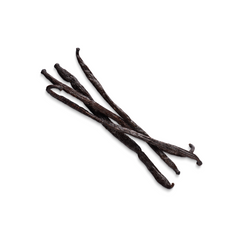
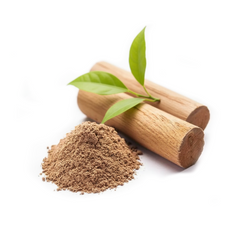
Jo Malone London Myrrh & Tonka (2016, Mathilde Bijaoui) showcases myrrh’s sweet, balsamic qualities, blending it with tonka bean and vanilla for a creamy, enveloping drydown. Dior Bois d’Argent (2004, Annick Menardo) employs myrrh as a bridge note, linking iris, incense, and woods to create a soft, incense-laden signature. Tom Ford Myrrhe Mystère (2023, Shyamala Maisondieu) elevates myrrh as a dominant note, surrounded by amber, vanilla, and sandalwood for a modern, opulent effect.
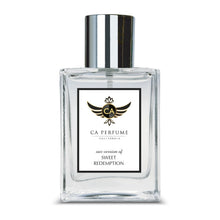
These fragrances demonstrate myrrh’s versatility: as a dominant note (La Myrrhe, Myrrhe Mystère), bridge (Bois d’Argent), or supporting base (Opium). CA Perfume’s collection draws inspiration from this lineage, offering myrrh-forward compositions that honor both tradition and innovation.
Natural vs Synthetic Myrrh in Perfumery
Natural myrrh is composed primarily of furanosesquiterpenes (furanoeudesma-1,3-diene, curzerene; CAS 566-62-7), with minor constituents like limonene and elemol. Synthetic myrrh is typically constructed from aroma chemicals such as furaneol (CAS 3188-00-9), myrrhone (CAS 67801-64-1), and synthetic curzerene. These molecules mimic the balsamic, bitter, and smoky facets of the natural resin but often lack its nuanced evolution and complexity.
Performance-wise, synthetic myrrh offers greater batch-to-batch consistency, improved stability, and enhanced longevity in high-alcohol formulations. However, natural myrrh’s fixative properties and multi-layered drydown remain unmatched. Cost is a major differentiator: natural myrrh absolute can reach $1,200/kg, while synthetic blends are available for $50–200/kg. Iconic fragrances like Jo Malone Myrrh & Tonka and Tom Ford Myrrhe Mystère use both natural and synthetic myrrh to balance cost, sustainability, and olfactory impact.
Sustainability is a critical factor: overharvesting of wild Commiphora myrrha threatens biodiversity, making synthetic alternatives attractive for large-scale production. The HumanSafe™ platform at CA Perfume ensures full traceability and IFRA compliance for all myrrh-containing formulas, whether natural or synthetic. In summary, while synthetics offer practical advantages, natural myrrh remains the gold standard for depth and authenticity in fine perfumery.